Database Migration Platform
Browser-operated any-to-any database migration on CDC
Built by Esparks IT Solutions · architecture & delivery led by Faiz Akram
Database Migration Platform is a browser-operated tool for planning, running, monitoring and validating real-time, CDC-based migrations between heterogeneous databases. The Esparks IT Database Migration Platform is deployed and running in a customer-controlled environment using Docker-based infrastructure, enabling organizations to operate migration workloads within their own infrastructure. A cloud-hosted deployment model is being explored to widen access.
A browser-operated platform for planning, running, monitoring and validating real-time migrations between heterogeneous databases. Five relational engines (SQL Server, PostgreSQL, MySQL, Oracle, Db2) migrate in either direction; MongoDB is supported as a CDC source. A Java control plane orchestrates jobs while a Debezium + Kafka data plane performs the change capture and delivery, with end-to-end reconciliation to validate every migration.
The Problem
Migrating between database engines usually means downtime, custom scripts, or an expensive vendor tool.
Every migration becomes a one-off script
Moving from SQL Server to PostgreSQL, or MySQL to Db2, usually means hand-rolled ETL that only works for that one pair.
Cutover means downtime
Without change capture, the only safe way to migrate is to freeze writes during a bulk copy.
Nobody can prove the migration is correct
Row counts get eyeballed, not systematically reconciled against the source.
A migration platform should treat "move data between engines without downtime, and prove it landed correctly" as the actual product — not an afterthought.
Results From a Real Deployment
- Rows migrated
- ~960M
- Across 405 tables and three databases, SQL Server to PostgreSQL, with the source system still live and being written to throughout.
- Largest single table
- 479M
- One table on its own. It kept streaming changes continuously while the rest of the estate was still loading.
- Rows missing
- 0
- Across all 401 tables compared row by row, every key present on the source was present on the target. Not a sample — all of them.
- Tables matching exactly
- 99.2%
- 384 of the 387 tables that could be measured. The three that differed were each explained — and none had lost data.
How It Works
- 1.Connect source & target
- 2.Pick your tables
- 3.Bulk load, then attach CDC
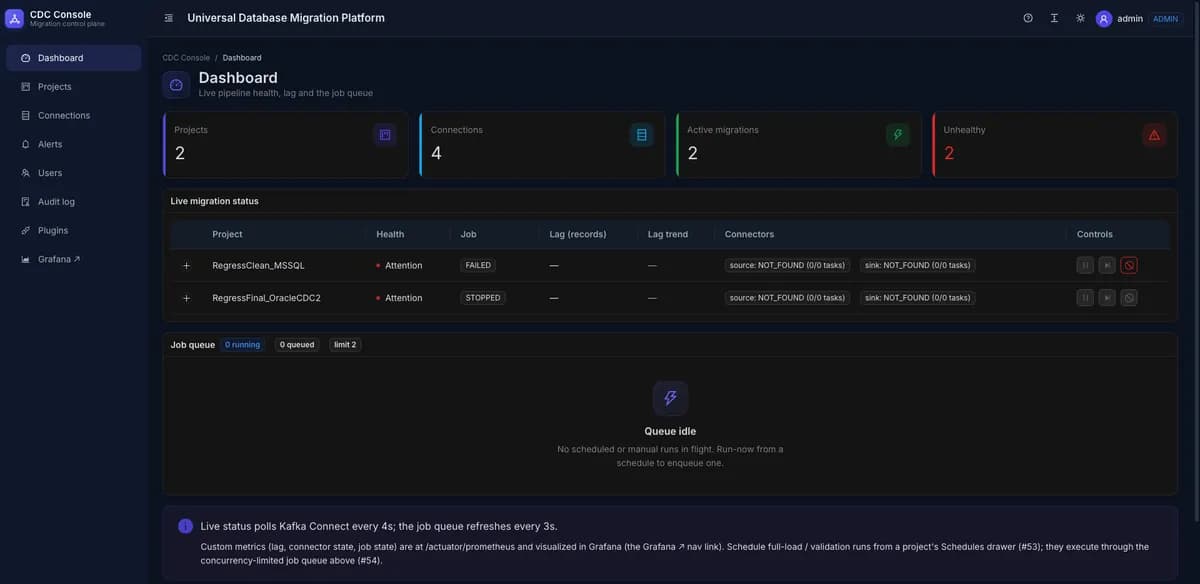
- 4.Watch it run
- 5.Reconcile and prove it
- 6.Handle exceptions
Key Highlights
- Any-to-any CDC migration across 5 relational engines, plus MongoDB as a source
- Real-time CDC: Debezium source → Kafka → JDBC sink
- End-to-end reconciliation with drift detection, across heterogeneous engines
- Custom Java SMTs, AES-GCM secret encryption, Prometheus/Grafana